
AI that analyses the retinal picture you already take.
MONA screens for diabetic retinopathy, diabetic maculopathy and glaucoma in seconds. You stay in charge of every decision.
Extensively validated.
In many peer-reviewed studies, including 2 published in Lancet journals.
Result in seconds.
From image upload to report.
One image per eye.
The picture your team already takes.
Capture, analyse, decide
- 01
Capture.
Your technician or nurse takes one image per eye, exactly as today. Most patients need no pupil dilation.
- 02
Analyse.
MONA analyses the image and returns a result in seconds.
- 03
Decide.
You review the full report and decide what happens next. AI analyses, you decide.
Why eye screening gets missed
About 1 in 5 people with diabetes have some degree of diabetic retinopathy. In high-income countries, about half of people with glaucoma are undiagnosed until the disease is advanced. Both are often silent, and the usual screening pathway is hard to scale.
Sources: Teo et al., Ophthalmology 2021; Quigley, The Lancet 2011.
The problem
What changes with MONA
The problem
The disease is silent. By the time symptoms appear, treatment is often too late.
What changes with MONA
MONA identifies risks early in the development of the disease.
The problem
Eye specialists are overstretched. An ageing population and rising diabetes are growing faster than ophthalmology capacity, and waiting lists are long.
What changes with MONA
A technician or nurse takes the image. Specialists see the people MONA flags.
The problem
Dilating drops are uncomfortable. Blurred vision can last for hours and stop people driving or working.
What changes with MONA
Most patients need no pupil dilation.
The problem
Awareness is low. Many people at risk never have a regular eye check.
What changes with MONA
Screening happens where patients already are: the diabetes clinic, the GP practice or the eye clinic.
How MONA performs
Sensitivity and specificity for referable disease. Referable means the eye should be seen by a specialist.
Diabetic retinopathy.
90% sensitivity.
95% specificity.
Of every 100 people with referable diabetic retinopathy, MONA flags 90. Of every 100 without it, MONA correctly clears 95.
Source: J Clin Med, 2023; 12(4):1408; Peeters et al.
Diabetic maculopathy.
91% sensitivity.
94% specificity.
Of every 100 people with referable diabetic maculopathy, MONA flags 91. Of every 100 without it, MONA correctly clears 94.
Source: J Clin Med, 2023; 12(4):1408; Peeters et al.
Glaucoma.
87% sensitivity.
97% specificity.
Of every 100 people with referable glaucoma, MONA flags 87. Of every 100 without it, MONA correctly clears 97.
Source: Internal data, available on request.
Trained and validated on over 273,000 images.
MONA in practice
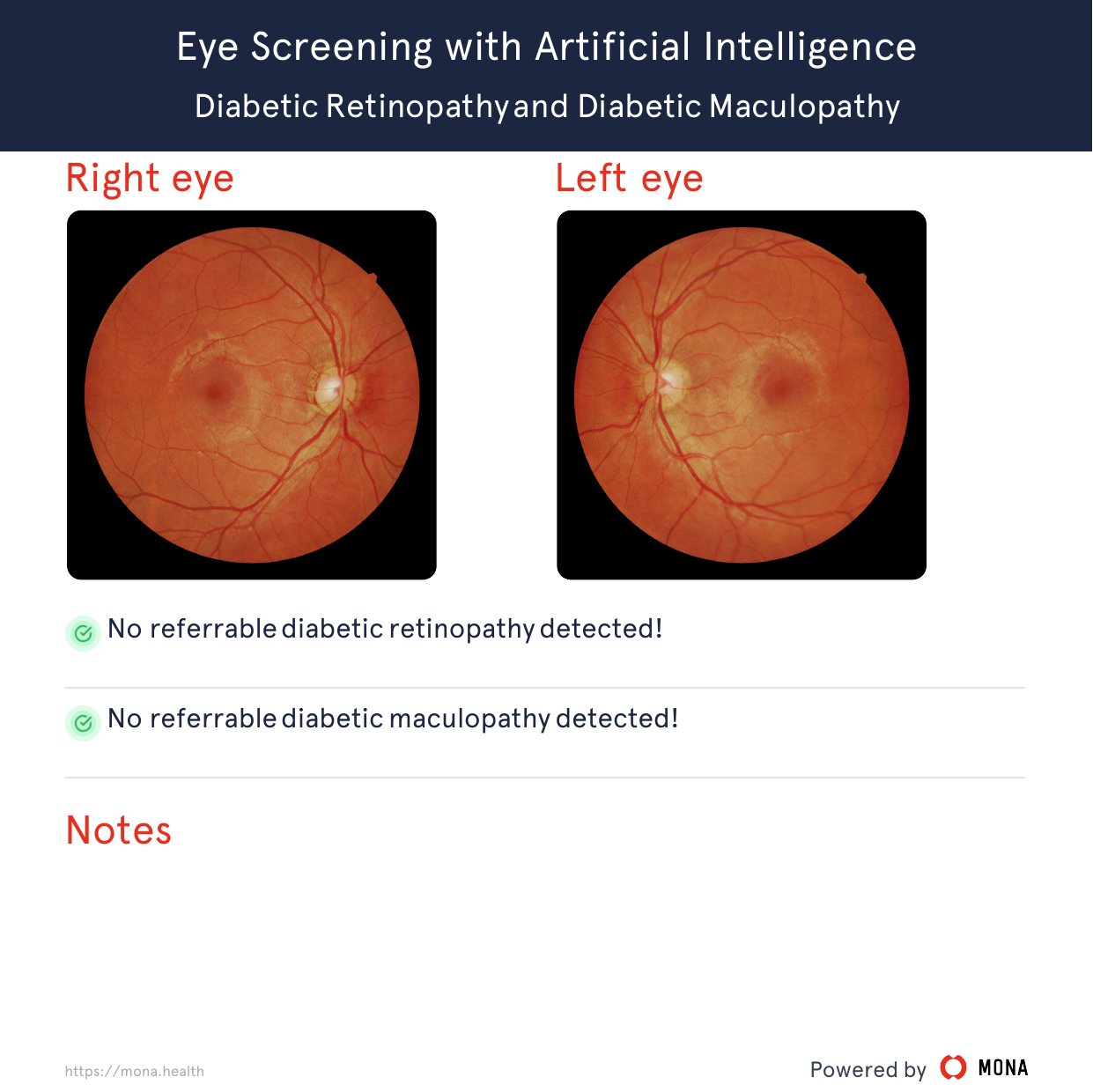
How MONA screens for diabetic retinopathy.
Where MONA fits
Eye clinics and hospital eye departments.
Add a screening analysis to the images you already take.
Diabetes clinics and primary care.
Screen at the diabetologist or the GP practice, close to the patient.
Screening programmes.
A standardised, documented analysis of every image.